Executive summary
VISIMO developed Pelarion to help scientific and technical reviewers work through fragmented evidence faster while preserving the source context and human judgment required for defensible review. The system is framed around review support, not reviewer replacement: it helps users screen, organize, and inspect evidence while keeping source provenance visible. In testing, the screening pipeline achieved 80% recall and 86% precision, giving reviewers a measurable way to prioritize work while retaining final decision authority.
Challenge
Scientific and technical review teams often work across large volumes of peer-reviewed literature, reports, PDFs, policy documents, technical memos, and grey literature. Traditional manual review can be slow, difficult to reproduce, and hard to audit when source quality, document structure, and relevance vary across a corpus. The challenge is not simply finding documents; it is screening them efficiently while preserving enough evidence to defend why each source was included, excluded, or flagged for further review.
- Evidence is often scattered across many document types and repositories.
- Manual screening can be slow and difficult to reproduce at scale.
- Review teams need transparent inclusion, exclusion, and source-inspection workflows.
Problem requirements
The system needed to accelerate review without obscuring how evidence was found, why a source was prioritized, or where each output originated. Reviewer authority, source provenance, and defensible review artifacts were central requirements, but the tool also needed measurable screening performance so users could trust it as a review accelerator rather than a black-box shortcut.
- Ingest and normalize technical documents and grey-literature PDFs.
- Prioritize likely relevant sources while preserving human review decisions.
- Create outputs that can be inspected, traced, exported, and defended.
Solution
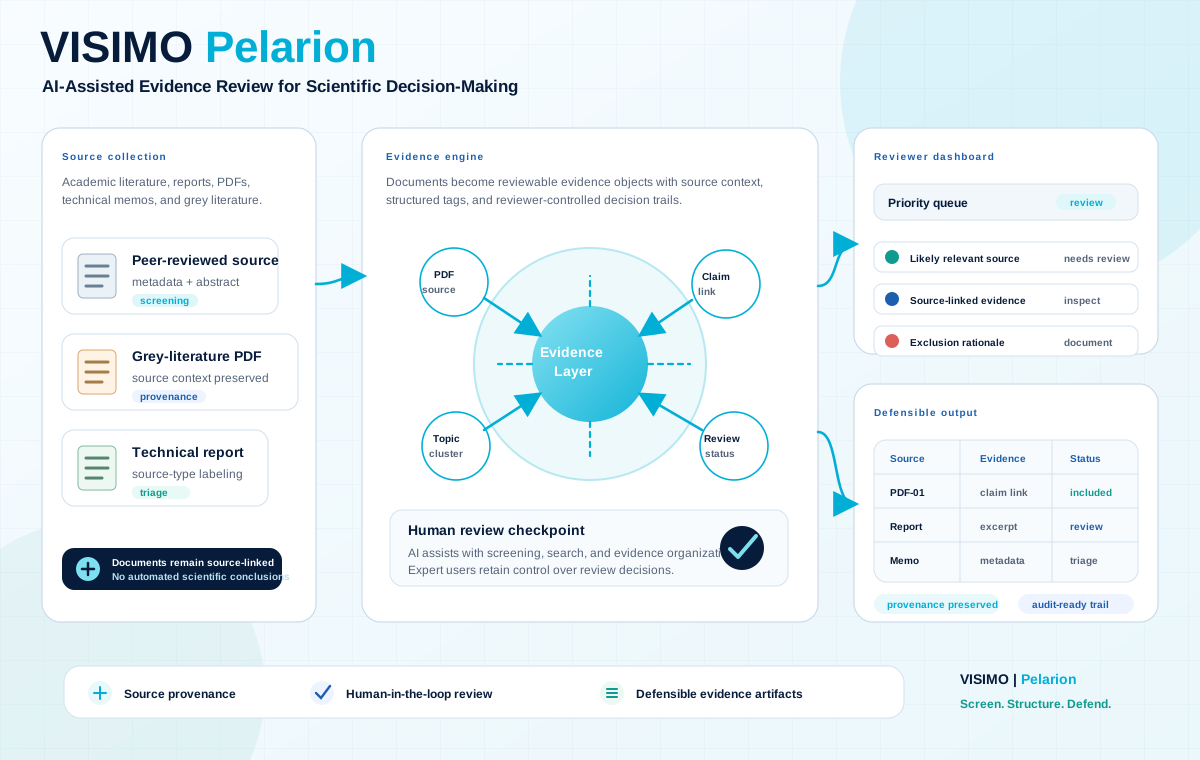
Pelarion combines document ingestion, AI-assisted screening, semantic search, and reviewer workflow support to help users identify relevant sources, inspect evidence, and preserve a reviewable decision trail. The public framing emphasizes evidence-grounded AI: the system helps experts reason over sources rather than generating unsupported conclusions.
- Grey-literature and technical-document ingestion.
- AI-assisted relevance and evidence triage.
- Source-linked outputs for expert review.
- Page-level anchors and rationale outputs for auditability.
Implementation
VISIMO used a software-first prototype approach to turn a fragmented evidence-review workflow into a structured, inspectable tool. The delivered application combined PDF normalization, sentence-aware document chunking, title and abstract extraction, lexical ranking, supervised learning, full-text screening, and reviewer-facing explainability panels. The system was built, deployed, and alpha-tested as a working web application with asynchronous processing for long-running tasks such as ingestion, de-duplication, metadata extraction, and model-assisted screening.
Results
Pelarion produced concrete screening and extraction results. The screening pipeline reached 80% recall and 86% precision across test datasets, balancing the risk of missing relevant sources against the workload created by false positives. Replacing the original title-and-abstract extraction method with an LLM-based approach improved extraction performance by approximately 50% and successfully extracted titles and abstracts from nearly every uploaded document. A custom metadata extraction feasibility test across 32 biomedical articles identified population size in 96.77% of cases and matched population characteristics in 100% of test documents. These results demonstrate why the system matters: reviewers receive measurable prioritization, traceable rationales, and structured metadata without giving up human control.
- Achieved 80% recall and 86% precision for model-assisted screening.
- Improved title and abstract extraction performance by approximately 50%.
- Demonstrated high-accuracy custom metadata extraction in a 32-article feasibility test.