Executive summary
EIKON was a VISIMO IR&D initiative focused on a common mission AI bottleneck: generating enough diverse, mission-relevant visual data to train and evaluate models before costly real-world testing. Building on earlier Air Force and Colorado State University synthetic landscape generation work, EIKON moved away from CGANs and explored diffusion-network methods for configurable synthetic imagery and scenario variation. The work mattered because it did more than produce plausible images: it showed measurable improvements in image-similarity metrics and demonstrated that synthetic imagery can improve object-detection performance when real training examples are scarce.
Challenge
Visual AI systems need large, diverse, carefully labeled datasets, but mission-relevant examples can be rare, costly, dangerous, or difficult to collect. Manual annotation can slow development, and early R&D teams may need to evaluate edge cases before real-world testing is practical. The most valuable synthetic imagery is therefore not generic image generation; it is controlled data generation that improves downstream model training and evaluation.
- Real-world collection may not cover enough rare or degraded conditions.
- Manual labeling can be expensive and difficult to scale.
- Mission AI teams need controlled scenario variation for training and evaluation.
Problem requirements
The solution needed to generate realistic visual environments, support configurable scenario variation, and create data that could be reviewed and used in AI training or evaluation workflows. To be useful, the generated imagery also needed to improve measurable downstream outcomes, especially when real image counts were too low for reliable model training.
- Generate realistic landscape imagery and visual scenarios.
- Support variation across terrain, lighting, visibility, and weather-like conditions.
- Create synthetic data that could augment training, simulation, and evaluation workflows.
Solution
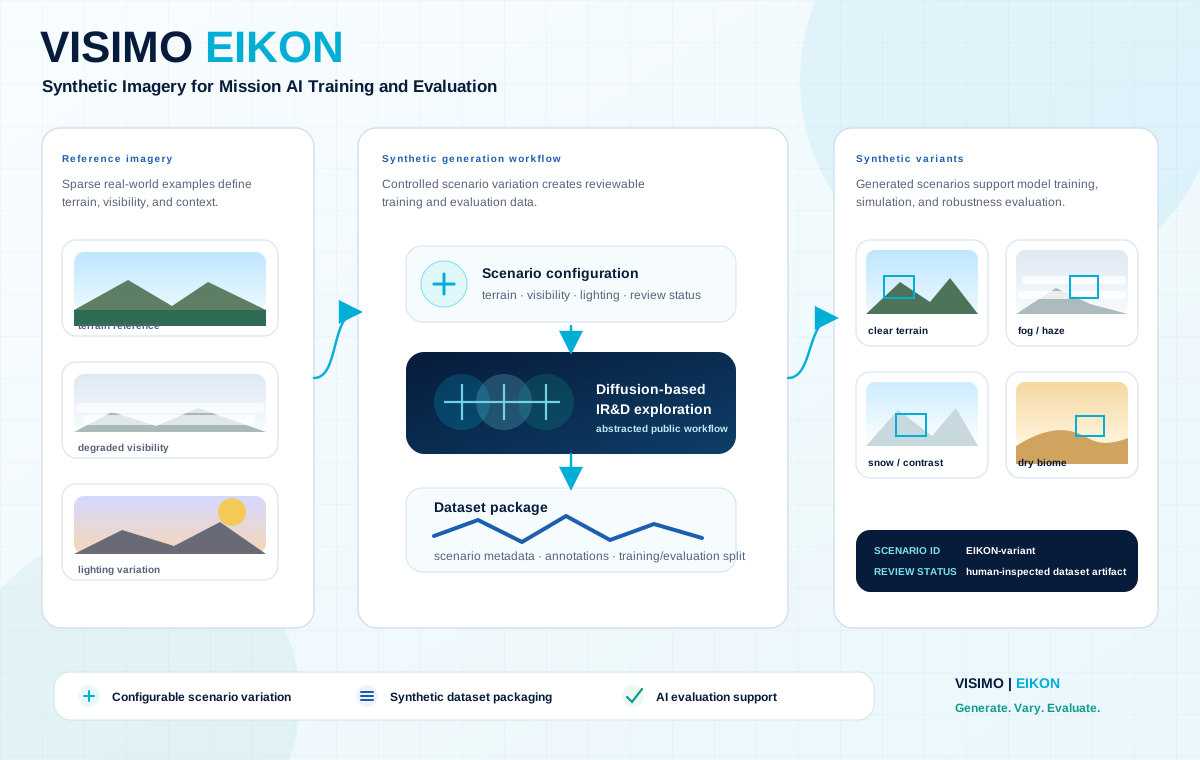
VISIMO developed a synthetic imagery workflow for generating realistic landscape scenes and mission-relevant visual variation. The IR&D effort evaluated a diffusion-network approach against the prior CGAN-centered lineage, then tested whether synthetic images could improve object-detection performance in low-real-data scenarios.
- Generative modeling for realistic landscape imagery.
- Configurable visual conditions such as terrain, lighting, visibility, and weather-like effects.
- Synthetic dataset construction for AI training and evaluation.
- Scenario-oriented outputs for model testing before field deployment.
Implementation
The research lineage began with a defense R&D need for scalable synthetic landscape data through Phase I and Phase II work with Colorado State University. EIKON was the later VISIMO IR&D step, using a diffusion-network approach to move beyond the earlier CGAN-centered architecture. The evaluation compared generated-image quality using FID and KID, then tested downstream utility by measuring object-detection Kappa and IoU across combinations of real and synthetic imagery.
Results
EIKON showed meaningful improvement over the prior CGAN-centered approach. FID decreased from 274.97 to 149.27, and KID mean decreased from 0.200 to 0.065, indicating that the diffusion-based outputs were closer to real imagery under the evaluation setup. The strongest downstream signal appeared in scarce-data object-detection tests: with one real image, adding 25 synthetic images improved Kappa from 0.0000 to 0.5523 and IoU from 0.0000 to 0.3933; with ten real images, adding 25 synthetic images improved Kappa from 0.2884 to 0.6442 and IoU from 0.1830 to 0.4883. These results show why the work matters: synthetic imagery can help close the training-data gap when real examples are limited, while still requiring human review and broader validation before operational use.
- Reduced FID by roughly 45.7% compared with the prior CGAN-centered approach.
- Reduced KID mean by roughly 67.5% for Stable Diffusion novel imagery.
- Improved object-detection Kappa and IoU in scarce-real-data augmentation tests.