Executive summary
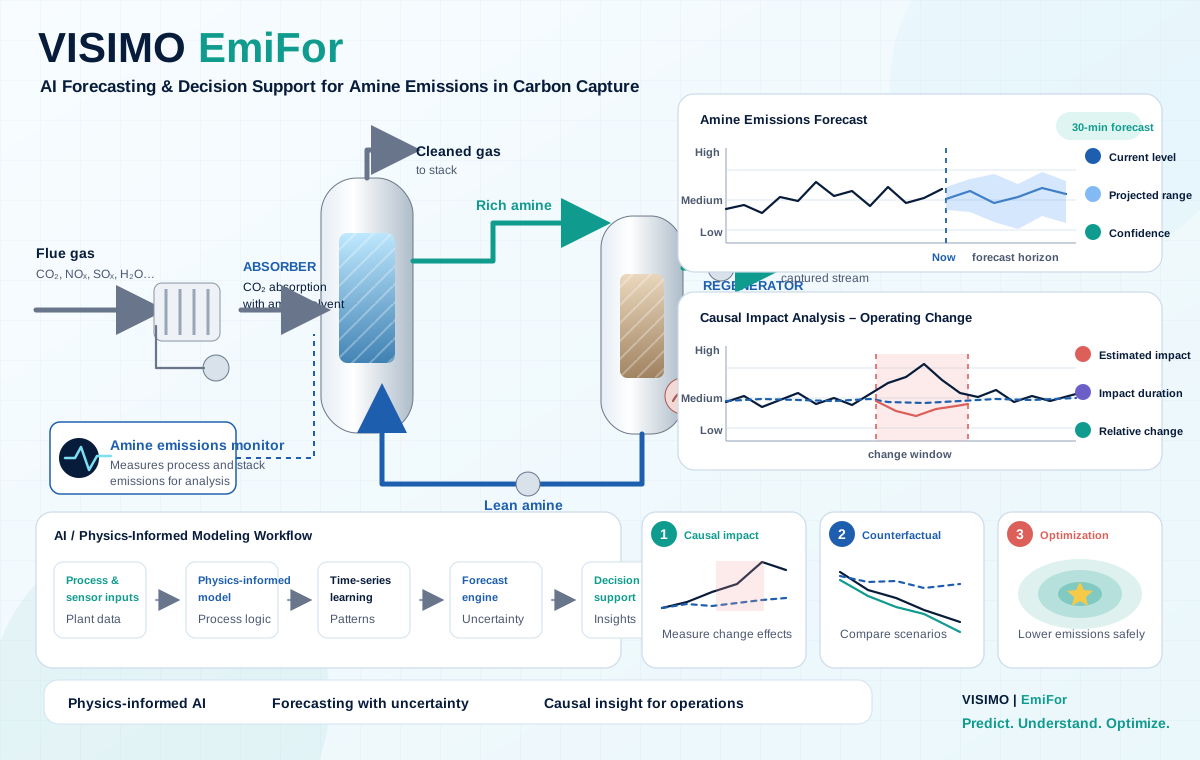
EmiFor is a forecasting and decision-support framework designed to help operators better understand and manage amine emissions in post-combustion carbon capture systems. During a DOE Phase I effort, VISIMO developed a proof-of-concept pipeline that combined machine learning, physics-informed modeling, synthetic data generation, and interactive analysis workflows.
Challenge
Amine-based carbon capture can help reduce carbon dioxide emissions from industrial systems, but plant operators must also manage the behavior of solvent-related emissions over time. Those emissions can be affected by operating conditions, transient events, solvent behavior, data quality, and limited measurement availability.
- Operators need short-horizon forecasts that reflect changing plant conditions.
- Limited and inconsistent measurement data can make model development difficult.
- Decision support must help users understand likely drivers, scenarios, and constraints.
Problem requirements
The solution needed to move beyond a static prediction model. It had to support a workflow where users could examine historical emissions, test alternative operating assumptions, and identify parameter settings that may reduce emissions while staying within realistic plant constraints.
Solution
VISIMO developed EmiFor as a proof-of-concept forecasting framework for amine-emissions prediction. The technical approach compared time-series learning methods with physics-informed modeling techniques designed to incorporate known process dynamics while still learning nonlinear relationships from data.
- Short-horizon forecasting for amine-emissions behavior.
- Physics-informed modeling patterns for process-aware prediction.
- Interactive workflows for causal impact, counterfactual analysis, and parameter optimization.
Implementation
VISIMO developed and evaluated forecasting models using a combination of pilot-scale observations, synthetic data, and process-informed assumptions. The work included exploratory analysis, synthetic data generation, model training, performance evaluation, and demonstration-application development. The public case-study framing intentionally generalizes the technical implementation while preserving the operational value of the work.
Results
The Phase I effort demonstrated that EmiFor could forecast amine emissions across a 30-minute horizon with strong model performance in evaluation settings. The work also showed that the framework could support decision workflows beyond prediction, including likely drivers of emissions changes, alternative operating scenarios, and parameter settings that may reduce emissions within defined constraints.
- Validated the feasibility of process-aware emissions forecasting.
- Demonstrated user-facing decision workflows for plant operations.
- Established a technical foundation for a more complete prototype application.