
FOR IMMEDIATE RELEASE | July 21, 2026 – Pittsburgh, PA
NASA has selected VISIMO's Model Validation via Precomputed Transformations project for SBIR Phase II. VISIMO will now work with NASA to negotiate the Phase II effort and, following successful contract execution, mature MVPT toward a mission-ready AI/ML validation capability for autonomous space systems.
VISIMO Selected for NASA SBIR Phase II to Advance MVPT for Mission-Ready AI Model Validation
PITTSBURGH, PA. – VISIMO has been selected by NASA to advance Model Validation via Precomputed Transformations (MVPT) through the Small Business Innovation Research (SBIR) Phase II program. The selection follows a successful Phase I effort demonstrating the feasibility of a model-agnostic approach for estimating whether artificial intelligence and machine learning models remain valid when autonomous systems encounter new, previously unobserved mission data.
VISIMO will now work with the NASA team to complete a successful contract negotiation. Phase II work will begin following successful negotiations and contract execution.
Autonomous spacecraft, planetary vehicles, and other remote systems increasingly rely on AI and machine learning to navigate, detect hazards, interpret sensor data, and make decisions without continuous human supervision. These systems are often deployed into environments that cannot be fully represented in pre-mission training data, creating a fundamental assurance challenge: a model that performed well before launch may encounter conditions in flight that it has never seen before.
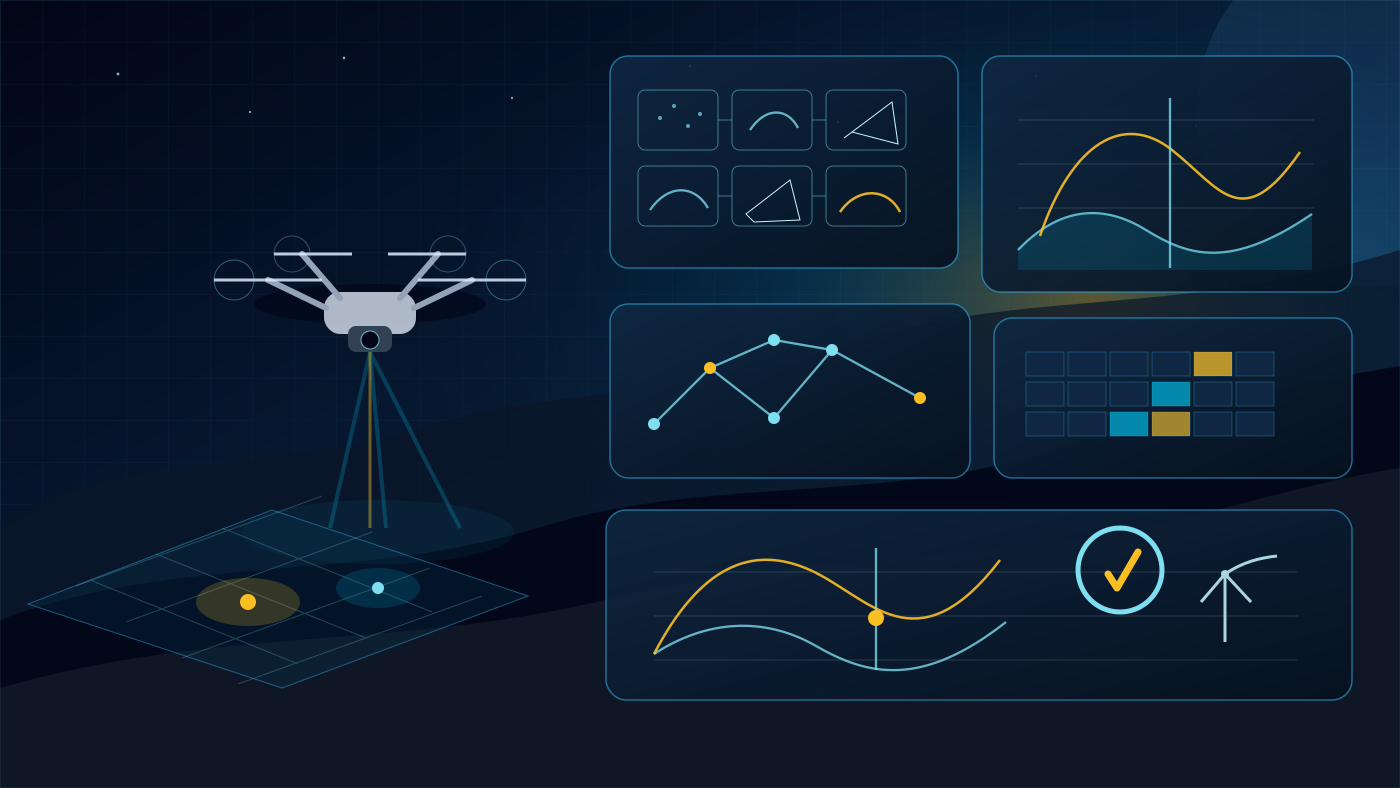
MVPT addresses that challenge by precomputing how model-validation results change across transformations of representative data before deployment. During a mission, a lightweight software component can compare newly observed data with those precomputed conditions and estimate whether the model remains valid without requiring exhaustive retraining or revalidation onboard the spacecraft.
“NASA's Phase II selection is an important validation of both the technical work completed in Phase I and the need for practical AI assurance in autonomous missions,” said James Julius, Founder and CEO of VISIMO. “The next step is to work closely with NASA through negotiations and then mature MVPT into software that can operate under the computational and reliability constraints of real mission systems.”
Phase I Demonstrated Technical Feasibility
During Phase I, VISIMO evaluated MVPT across NASA-relevant machine learning technologies and demonstrated broad applicability. The research found MVPT compatible with 97.9% of evaluated NASA-relevant machine learning models, 87% of evaluated validation methods, and 89% of evaluated data modalities.
The Phase I proof of concept also correctly predicted model validation in 95% of evaluated cases using near-term NASA solar-wind data, providing quantitative evidence that the underlying approach can estimate model validity as incoming data changes.
Maturing MVPT from Proof of Concept to Mission-Ready Prototype
The proposed 24-month Phase II effort is designed to advance MVPT from Technology Readiness Level 4 to Technology Readiness Level 6. VISIMO plans to evaluate the technology using a NASA-relevant extraterrestrial rotorcraft mission simulation incorporating navigation-camera data, physically informed surface simulations, and ground-truth labels supporting height-variance estimation, hazard detection, and feature tracking.
Phase II will focus on four major objectives: creating realistic simulated training and mission data; validating MVPT's accuracy and reliability; demonstrating that the mission-side software can meet spacecraft computational constraints; and packaging the technology into a reusable software prototype with documentation and application programming interfaces for mission and engineering workflows.
Performance targets for the Phase II prototype include model-validity estimates with less than 5% error, mission-side memory use below 128 MB, and results generated in less than three seconds on a 200 MHz processor. VISIMO also plans to evaluate the mission-side software in a VxWorks environment representative of spacecraft computing architectures.
Building AI Assurance for Autonomous Exploration
If successfully matured, MVPT could provide a reusable validation layer for autonomous NASA missions operating beyond reliable or immediate human assistance. Potential applications include deep-space and planetary autonomy, near-Earth autonomous spacecraft operations, Earth-observation systems, and other mission environments where AI/ML models must continue operating safely as conditions change.
The technology also has potential applications beyond NASA in commercial space systems, autonomous aerospace platforms, unmanned aircraft, robotics, and other safety- or mission-critical environments where organizations need a practical way to understand whether deployed models remain trustworthy as incoming data shifts.
About VISIMO
VISIMO is a Pittsburgh, Pennsylvania-based AI and software engineering company founded in 2015. VISIMO builds applied machine learning, data science, and mission software solutions for federal agencies and commercial partners, with a focus on rapid prototyping, defensible AI, autonomy, and decision-support systems. VISIMO specializes in transforming complex data and technical uncertainty into practical tools that support better decisions in high-consequence environments.
Media Contact:
VISIMO Media Inquiries
VISIMO
412-699-6900
media@visimo.ai
Selection Status:
NASA has selected the MVPT effort for SBIR Phase II. Phase II work is subject to successful contract negotiations and contract execution with NASA.